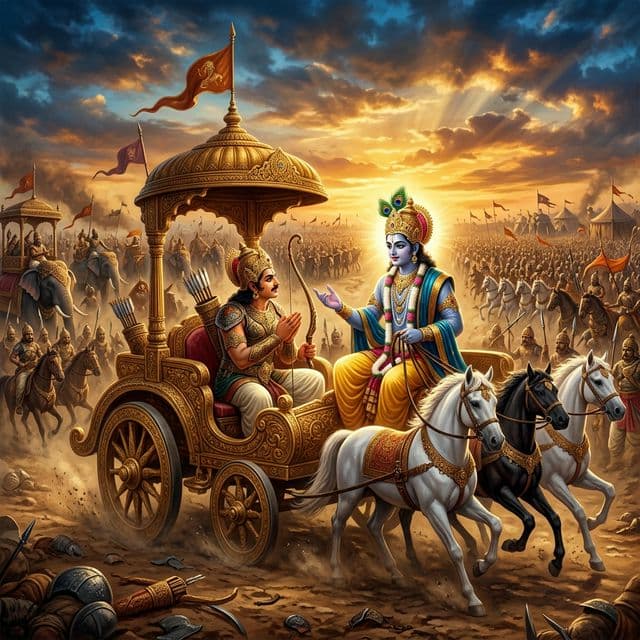
The Bhagavad Gita (भगवद्गीता) - "The Song of God" - is a 700-verse dialogue between Lord Krishna and the warrior prince Arjuna on the battlefield of Kurukshetra. While it was spoken over 5,000 years ago, its insights on duty, anxiety, purpose, and selfless action are astonishingly relevant to modern life.
Lesson 1: You Have the Right to Work, Not the Fruits
Verse 2.47: "कर्मण्येवाधिकारस्ते मा फलेषु कदाचन" "Karmanye vadhikaraste Ma Phaleshu Kadachana"
This is arguably the most famous verse in the Gita. Krishna tells Arjuna: You have the right to perform your duty, but you are not entitled to the fruits of your actions.
Modern Application: In a world obsessed with outcomes - promotions, followers, likes, exam results - this verse teaches us to focus on the quality of our effort rather than the anxiety of the result. A student who studies with full dedication but detaches from result-anxiety will paradoxically perform far better than one who is consumed by fear of failure.
Lesson 2: Change is the Only Constant
Verse 2.22: "वासांसि जीर्णानि यथा विहाय..."
Just as a person discards old clothes and puts on new ones, the soul discards old bodies and enters new ones.
Modern Application: Whether it's a job loss, a breakup, or a life transition - this verse reminds us that change is not the enemy. Every ending is a beginning. What feels like destruction is actually transformation.
Lesson 3: Conquer the Mind, and You Conquer the World
Verse 6.5: "उद्धरेदात्मनात्मानं नात्मानमवसादयेत्"
Elevate yourself through the power of your mind, and do not let yourself be degraded. The mind can be both your best friend and your worst enemy.
Modern Application: Modern neuroscience confirms what Krishna said millennia ago - neuroplasticity proves that you can literally rewire your brain through meditation and disciplined thought. Your mind is a tool; learn to master it.
Lesson 4: Equanimity in Success and Failure
Verse 2.48: "सिद्ध्यसिद्ध्योः समो भूत्वा समत्वं योग उच्यते"
Perform your duty with an even mind in success and failure. This equanimity is called Yoga.
Modern Application: The startup world, the corporate ladder, and even relationships are filled with highs and lows. True mental health comes from maintaining emotional balance - celebrating success without arrogance, and handling failure without despair.
Lesson 5: Selfless Service (Seva) is the Highest Purpose
Verse 3.19: "तस्मादसक्तः सततं कार्यं कर्म समाचर"
Therefore, without being attached to the results, perform your duty as service. One who works selflessly attains the Supreme.
Modern Application: The happiest people in the world are not those with the most wealth, but those who live in service of others. Whether it's volunteering, mentoring, or simply being kind to a stranger - selfless action creates deep, lasting fulfillment that no material success can match.